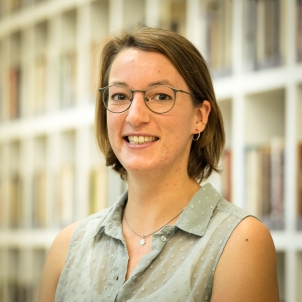
An interview with Dr. Natascha Roos
What was the main question in your dissertation?
When I first started my PhD, in September 2019, I wanted to investigate how language recovers in the brain after people have suffered a stroke. This was mostly because I was fascinated by cases in which people were hardly able to speak at all shortly after the stroke incident, but managed to recover most or even all of their communication abilities within the following weeks or months. As this turned out to be quite a complex and tricky investigation, my dissertation mostly focuses on the methodological aspects surrounding the question “How should we investigate language recovery after stroke?”. Based on two longitudinal and one single-session study in which I used different methods of looking at the brain activity, I explored the suitability of these different methods to investigate language recovery after stroke.
Can you explain the (theoretical) background a bit more?
We still do not know much about how the brain recovers language after stroke: Which brain processes are at play, and are they helpful for language recovery or do they perhaps hinder it in some way? So far, it has been found that a stroke on the left side of the brain can lead to a recruitment of the same areas in the right side of the brain to potentially support the patient’s ability to use language. However, this is an ongoing debate and most previous research has adopted very different approaches to investigate this. It therefore remains difficult to draw general conclusions about the ongoing processes in the brain after stroke and determine which are helpful or hindering for language recovery.
Why is it important to answer this question?
If we want to be able to improve treatment and therapy for people right after having suffered a stroke as well as during the recovery phase, it would be helpful to know more about how the brain deals with a stroke. Especially since strokes tend to differ between people. Not only because every person’s brain is unique, but also because strokes occur in different locations in the brain and can be big or small. Ultimately, it would be great to have more information about the recovery from different strokes and brains to use for more individualized treatment and care for newly incoming stroke cases. If we could determine which brain areas support specific functions (e.g. language) after stroke, we could increase the chances of these areas becoming involved in these functions by using brain stimulation techniques. These are non-invasive techniques, like placing a magnet over the scalp, that allows to boost activity in targeted parts of the brain.
Can you tell us about one particular project (question, method, findings, implications for science or society)?
For my main project, my goal was to investigate language recovery after stroke using a holistic approach. I designed a project where I tested people 2 and 7 months after a stroke on the left side of the brain. More specifically, I measured how their brain activity changed during a language task, collected various pictures of their brain, and measured their ability to think and speak using a number of additional tests. I also included an age- and education-matched control group of people without a stroke; as well as a stroke-control group of people with a stroke in the right side of the brain, who usually do not suffer from language impairments. Ultimately, such a rich and multidimensional data set can hopefully shed more light on the recovery of language in the brain after stroke.
Can you share a moment of significant challenge or failure during your PhD journey and how you overcame it?
Running such a huge and longitudinal project as I did was quite intense. After years of recruiting and testing people for this study, I realized that I was not going to advance on analyzing any of the data I had been collecting as long as I was still the only one responsible for new data coming in. Luckily I was able to get some help and could pass most of the recruitment and testing responsibilities to others. That way, I was able to start some of the analyses and write a chapter about this project to be included in my thesis.
What was the most rewarding or memorable moment during your PhD journey?
Most memorable was probably the day of my PhD defense on February 28th, where I got to present my research to a mostly lay audience of people outside of academia. I always find it very special and inspiring to communicate my work to the general public, outside of the ‘scientific bubble’ that we are usually in as academics, and this time it even included family and friends. Presenting my work for the last five years and receiving such positive feedback that people were able to follow and understand what I had been doing was very rewarding. In terms of feedback in general, though, the day of the defense is quite intense, as you seem to receive (too) many compliments that apparently had been partly lacking during the four to five years of the PhD trajectory.
What do you want to do next?
I am currently continuing my work on the longitudinal stroke project as a postdoc. Next to that, I started a 3-year study to become a dog trainer. My dream would be to merge both ‘fields’ and do cognitive neuroscience research with dogs while offering coaching for people who have difficulties with their dog.