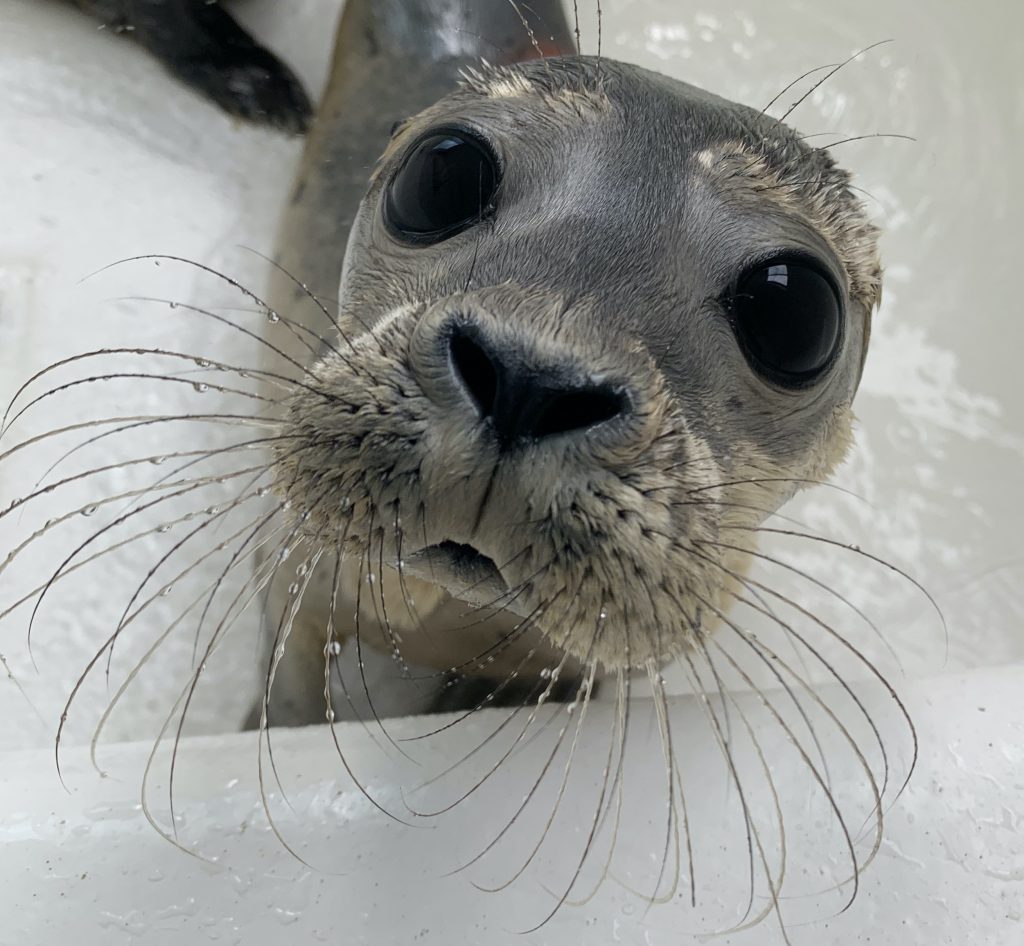
Seals may be more similar to us than we think. They are one of only a handful of animal groups capable of vocal learning: the ability to modify the sounds they make based on experience. At the InScience Film Festival, researcher Koen de Reus explained what more than 1,000 hours of recordings of seal pups in Seal Sanctuary Pieterburen reveal about how seals communicate.
By Jitse Amelink
Before we get to the latest research, we have to rewind the tape a bit. This story starts with someone who sounds a lot like a rough and rowdy New England sailor: Hoover the harbor seal. Hoover was found as a pup, kept as a pet and then moved to the New England Aquarium in Boston, where he lived from the early 1970s until his death in 1985. He imitated his owners and could say things like: “Hello there” and “Come over here”. However, science left that as a rarity for a while.
The Amazing True Story of Hoover the Talking Seal
Vocal learning comes in useful
Hoover being able to talk is evidence of what scientists call vocal learning. Vocal learning is the ability to modify or produce calls based on experience. It is one of the essential building blocks for language. Koen explains: “Across the animal kingdom it is found in birds, such as parrots, hummingbirds and songbirds, and mammals, such as elephants, bats, whales, dolphins, seals and humans. It evolved not just once but multiple times separately in the tree of life.” This suggests the skill may be useful in many different species.
For decades Hoover was treated as a curiosity. But researchers have since realized that his abilities may not be so unusual after all. Vocal learning comes in handy particularly early in seal life. Seals reproduce in groups. Seal pups call to signal hunger to their mother and to let her know where they are, when the mother comes back from fishing. Their calls are unique and recognizable to their mothers, but also to a trained human ear.
If you only have a short time with your mother, you might want to make the most of it. Common seal pups spend only three to six weeks with their mothers, even though they can live up to 30–35 years. That’s not a lot of family time. To make the most of it, these pups’ calls change the most in those early weeks.
Koen’s findings are based on a lot of hard-won groundwork. He recorded over 1,000 hours of seal pup calls in Seal Sanctuary Pieterburen, in the North of the Netherlands. Based on this work he identified three key elements for vocal learning in seal pups: turn-taking, vocal modifications, and vocal allometry, which is the relationship between body size and vocal pitch.
Turn-taking
Turn-taking is an essential aspect of human language. Humans start speaking almost immediately after the other stops, with gaps of only 200 milliseconds between turns. Sometimes, we even start too quickly and our turns overlap.
Koen tested this in seal pups. “We tested how pups responded to playing back earlier recorded seal calls.” As it turned out, seal pups know how to take turns. “They need on average 287 milliseconds to switch between turns, and there’s an alteration pattern: a long pause between turns, followed by a short one, and vice versa.” Seal pups are basically naturals.
Seals modify their calls
A key aspect of vocal learning is whether an animal can change its calls when there is noise or in different social environments. It turns out seal pups can do this as well. Koen: “They can lower their pitch in a noisy environment, so the sound carries further.”
And it’s not just environmental noise. Socially elicited changes happen as well. The pups in Pieterburen are housed in different buildings and each building seems to have its own “dialect” of pup calls. New pups adjust to the local dialect too, just as human children do if their family moves cross-country.
Enhanced neural control on the vocal cords
In addition to these other phenomena, seals seem to violate one of the global patterns of the animal kingdom: vocal allometry. All across the animal kingdom, a larger body usually goes with making lower-pitched sounds. There’s a lot of variability in this tendency, but even so, seals stand out. They can make much higher and lower sounds than would be expected given their body size.
The question is why? Could the anatomy of their vocal tract explain it? “No, there are no anatomical differences in the vocal tract. The anatomy of the vocal tract seems to follow body size, with some caveats for sex and age” says Koen.
This leaves another possibility: seals may have unusually precise neural control over their vocal cords. That kind of neural control is thought to be important for vocal learning in humans and birds. “However, that would need to be tested directly in neuroimaging experiments.”.
Implications for language evolution
Koen’s main take-away is this: “We humans are not as unique as we tend to think.” Turn-taking happens more often in the animal kingdom than we previously thought. Seal pup voices even break during puberty, like human teenagers.
And we can understand more about why humans have language from looking at other species too. Many of the building blocks of language – such as vocal learning and turn-taking – appear elsewhere in the animal kingdom. Seeing each of these pieces in other species can help us better understand how they all come together in humans. In this sense, when we look at other animals, we catch a glimpse of ourselves.
Sources:
https://royalsocietypublishing.org/rstb/article/378/1875/20210477/109183
Credits:
- Writer: Jitse Amelink
- Editor: Anniek Corporaal
- Second editor: Anna Mai
- Dutch translation: Anniek Corporaal
- German translation: Jule Hafermann