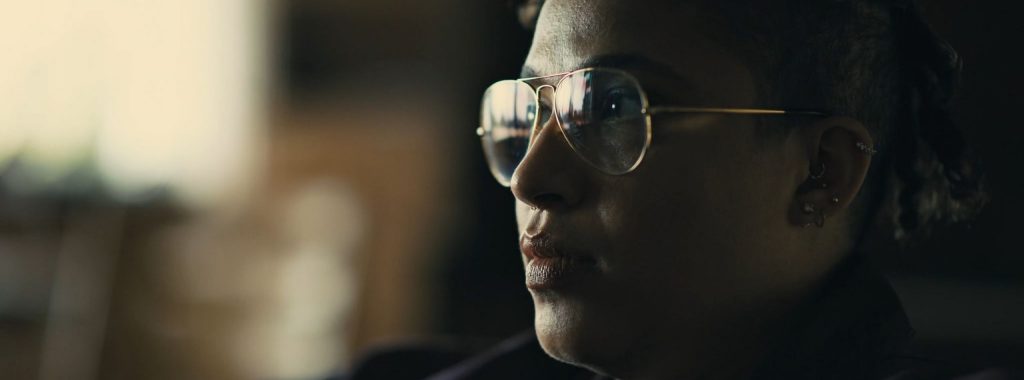
Why do people engage in hate speech online? TalkLing attended a screening of the documentary “Hacking Hate” at the 10th anniversary of the InScience Film Festival. In the film, we follow investigative journalist My Vingren on her journey into a world of hate on social media.
It’s not a pretty world My Vingren dives into. She is a Swedish journalist who goes undercover online to infiltrate radical online groups. With a fake profile of a proud, for emergencies preparing Swedish father, morphed from her own face, she encounters people that promote racism, terrorism and conspiracy theories with memes, against the backdrop of picturesque houses of Sweden.
Social media is the modern stage for political discourse
The place under investigation is social media. Vingren’s apartment is full of light contrasts with the YouTube influencers she investigates, who often violate YouTube’s policies. When Vingren sits in a meeting room at the headquarters of YouTube in Sweden and asks about this content, the representative will not admit that it exists. Social media platforms often have no incentive for forcing bans on far-right content, as that outrage generates revenue.
But in today’s world, social media is the stage on which we collectively interpret events. It’s part of the political discourse. Political discourse is about what meaning is given to events and what knowledge circulates that influences political thoughts and actions. Already classical Greek and Roman thinkers knew of rhetoric as a powerful political weapon for shaping political belief and action. The words that are used direct our attention to certain things and away from others.
Searching for a sense of belonging
People’s opinions are not only influenced by the ideas that they encounter, but also the context in which they do so. Social media creates the impression of a gathering of many assumed peers. Seeing the same extremist content over and over creates the feeling that this is normal, especially when we see others accepting it as well. It makes our social norms shift. Social norms are the unwritten rules of what we think everybody does or thinks, and how we think others expect us to act.
It does not matter if it is about far-right, jihadism or left-wing hate. People become radicalized by the promise of being part of something bigger than themselves, becoming active, changing the establishment in a radical way. It is natural for humans to want to be part of a group and to have shared goals, as this is the evolutionary niche that we created for ourselves.
Vingren gets invited to a private Telegram channel. The members are mostly young men, looking for a sense of belonging and community. One member explains that he thought this was finally something real, not just another channel for so-called ‘trashposts’ (ironical low quality posts intended to derail the conversation).
Countering hate
Seen from this side, it is clear why just countering the message is flawed. A war of words can give these groups greater legitimacy and reinforce their linguistic frames. However, researchers recently found that those people who did not radicalize while their peers did, had social anchors that offered purpose and belonging, like family members or being part of action-oriented groups.
To counter hate speech, social media platforms should not give it as much reach. Hate should not become the social norm. But we can also counter it together: by giving people the feeling that they can actively do something for, and belong to, a better world – one without hate.
Writer: Carmen Ramoser
Editor: Jitse Amelink
Translation German: Carmen Ramoser
Translation Dutch: Anniek Corporaal
Photo: Tony Johansson