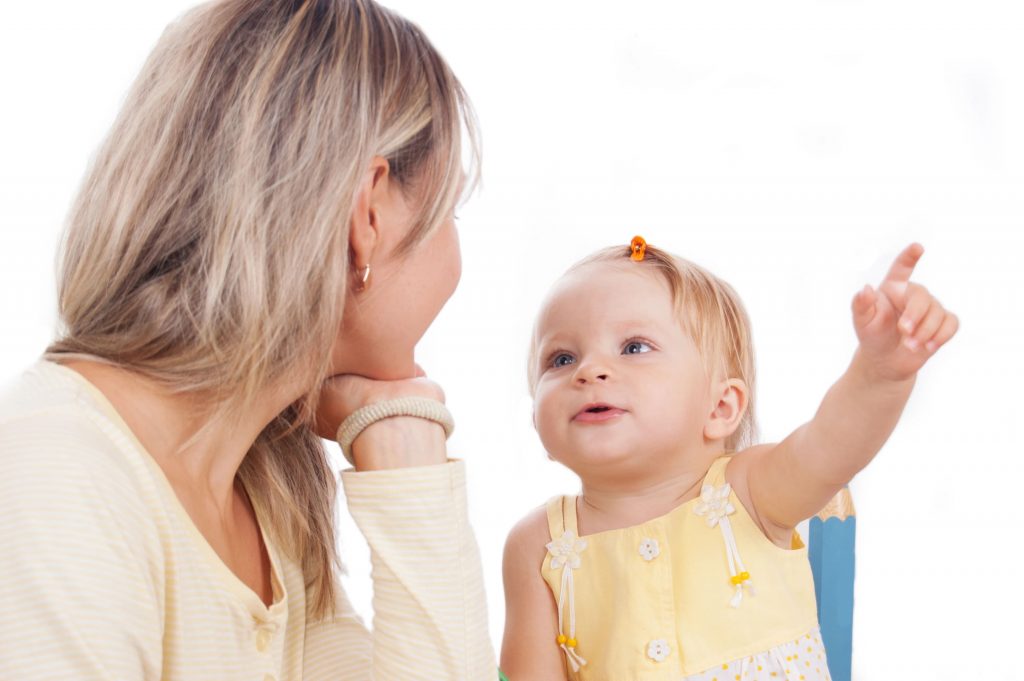
I recently saw a group of policemen in the supermarket. They were probably grabbing lunch, when a toddler wanted to say hi. Instantly, these very serious looking men started to talk in a sweet, silly way to this curious toddler, putting a big smile on the faces of passers by. Surely you know what this is – it’s babytalk. As the name suggests, we use it with babies, but also with pets, romantic partners, plants, and, perhaps surprisingly, with foreigners, people with learning difficulties, and the elderly. But why are we doing this?
Before we explore some possibilities, there is not one single reason why humans use baby talk (which is called infant/child directed speech or language in the scientific literature). Baby talk depends on our culture, the situation we are in, and who we are talking to. But since we only use it for specific audiences, what is it about the listener that makes us baby talk?
Adorable?
The first idea that may come to mind is that baby talk is a sign of affection. We are attracted to babies and anything that resembles them – big eyes, round faces, tiny bodies – because of an evolutionary-shaped concern for our offspring, which spills over to others who remind us of them. Baby talk might be one way to show those who look adorable that we are going to nurture and keep them safe. This explains why adults use more “intense” baby talk with younger children, children with more baby-like faces, and with puppies than with old dogs.
Babytalk may have started with babies, but caring for someone makes many people babytalk even though an adorable face (or a baby) is not necessarily involved, such as with partners, friends, or the elderly. It is a way to show affection and commitment, but also to promote intimacy. A response to the baby talk is not even necessary: think of your beloved houseplant or teddy bear.
Yet, while in many cultures (especially Western ones) baby talk is associated with something being adorable, this might not be the case everywhere. There are communities that use little to no baby talk or even choose not to talk to young infants that much at all, showing that baby talk is not the only way to connect to and show to care for one’s children.
Lacking competence?
Another possibility is that we switch to baby talk when we think others cannot understand our fast-paced normal speech, for example, because of hearing or a learning difficulty. In many cultures, baby talk is slow, uses shorter sentences, simpler words, and exaggerated stress. Thus, it could help communicate with children who have just started to learn to talk, and it could make it easier for foreigners to understand a language they have not fully mastered yet.
Small children, foreigners, people with disabilities, or older adults are often perceived by others as less competent (even if they aren’t) and, thus, in need of simpler speech. Indeed, toddlers perform better at some language tasks presented in this style than in normal speech. This is a sign that, for them, baby talk is easier to understand.
But this is not the complete story. We tend not to switch back to the usual adult-directed talk when our conversation partner, be it a child or an older person, shows clear signs they understand us well. In addition, some features of baby talk actually make understanding more difficult for some groups. For example, studies show that exaggerating the pronunciation of words might actually hinder understanding for older adults. And last but not least, there are cultures where baby talk has features one would expect to make understanding harder rather than easier: for example faster pace or less clear sounds. This could either mean that baby talk is not primarily used as a simplification of language, or that different communities might have different views on which modifications are making language easier to understand and which not.
Inferior?
“Don’t talk to me as if I were a baby!”. Baby talk can sound patronizing, which is why older children often resent being addressed this way. There’s an obvious power imbalance in a baby talk conversation: one person has the role of the child, and the other is the parent. If the speakers are an actual young child and parent, this is often okay, but people can take offence when they are not a child, but a patient, a foreigner or an elderly person.
While some use baby talk to show care or to ease communication – sometimes unintentionally offending others – there are people who use it to discredit those they regard as inferior. For example, baby talk shows up often in disagreements, where one party does not take the other seriously. Here baby talk is not an attempt to improve communication, but rather to claim a superior position, to show that one conversation partner does not regard the other as their equal. Imagine someone saying in a high pitch: “Aww, you think this is a good idea, don’t you?”.
An Ongoing Discussion
Finally, we should keep in mind that maybe not all baby talk is the same. There is an ongoing discussion about whether baby talk is a single style or several. Researchers distinguish primary from secondary baby talk. Primary baby talk is the one addressed to children and secondary baby talk is used for baby talk to everyone else.
Depending on the listener, some features of baby talk are more prevalent than others. For example, baby talk to foreigners is louder while baby talk to babies is softer. It is clear that one reason why people use baby talk is to match their conversation partner. Still, researchers are still busy finding out how many baby talk styles there are and what makes them special.
Writer: Magda Matetovici
Editor: Izabela Jordanoska
Translation Dutch: Anniek Corporaal
Translation German: Jule Hafermann
Further readings:
Ben-Aderet, T., Gallego-Abenza, M., Reby, D., & Mathevon, N. (2017). Dog-directed speech: why do we use it and do dogs pay attention to it?. Proceedings of the Royal Society B: Biological Sciences, 284(1846), 20162429.
DePaulo, B. M., & Coleman, L. M. (1981). Evidence for the specialness of the” baby talk” register. Language and Speech, 24(3), 223-231.
Efeoğlu, E., Erdoğan-Öztürk, Y., & Güler, H. I. (2021). Why Do Adults Use Baby Talk in the Online Space? Baby Talk as a Pragmatic Face Device in Adult Communication. Cankaya University Journal of Humanities and Social Sciences, 15(2), 311-329.
Kalashnikova, M., Carignan, C., & Burnham, D. (2017). The origins of babytalk: Smiling, teaching or social convergence?. Royal Society open science, 4(8), 170306.
Zebrowitz, L. A., Brownlow, S., & Olson, K. (1992). Baby talk to the babyfaced. Journal of Nonverbal Behavior, 16, 143-158.