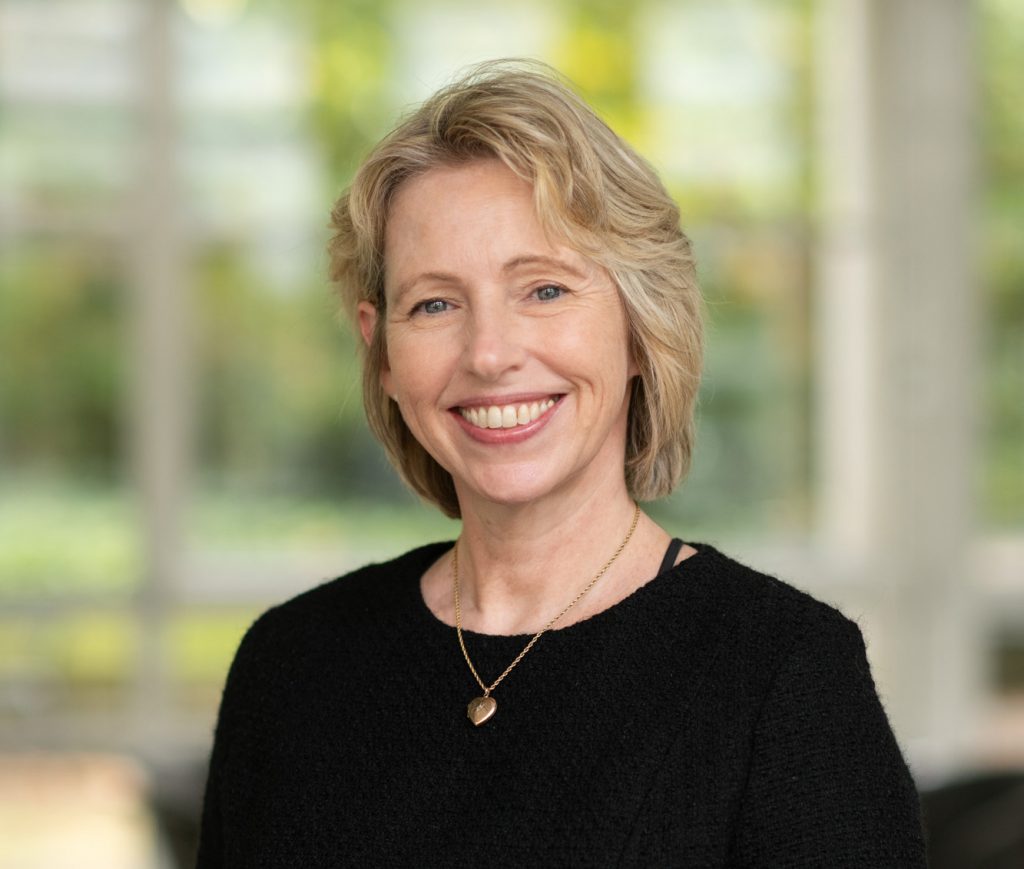
Sometimes, doing things differently really pays off. This is Caroline Rowland’s story. She is director of the Language Development department at the Max Planck Institute for Psycholinguistics. She went from secretary training into a part-time PhD, and from there straight into an assistant professorship before she even obtained her degree. Family life was a key factor in her career trajectory, and in part fueled her drive to seize any opportunity.
Caro, you had quite a different journey to your professorship. What did that journey look like? And how did your personal life play into this?
“I think we need to go back to before my PhD. After my bachelor’s I wasn’t considering going into research, but Elena Lieven offered me a research assistant job in Nottingham, probably because I had very strong secretarial training and good organizational skills. So I took that job and took my husband with me.
And after a year, when we had our first baby, I started to get interested in research, so I asked my boss: ‘can I do a part-time PhD?’. This was not as bad as it sounds though. I was doing my work as a research assistant during the day and would do the analyses and writing in my free time. I could carve out a part of the project, the Manchester corpus, that was my own and we would collaborate with the four of us to write these papers. Based on these, I got a tenure-track assistant professor position, actually before I finished my PhD.
I actually had a second baby during my PhD. My supervisors weren’t too happy at first, but luckily, they were very supportive later. But as my husband was a student nurse, we needed both his stipend and my salary to make ends meet. I remember being terrified that our washing machine broke and we didn’t have any money to mend it, so my parents gave us some money. So yeah, we were living hand-to-mouth.
I did try and take every opportunity that was given me. When I was a senior lecturer, I was offered to follow a leadership course for future research leaders, and although I could have said no, I decided it was important and did it anyway.
I think this course taught me a lot about people management, like onboarding people, leading teams properly, being transparent and honest, admitting your mistakes — those sorts of skills that academics don’t normally get. I’d say it was a lot of work, but I think it made this job, for example, a lot easier because I kind of followed the advice I was given. I think being supportive is really important to my ethos, that people can come to me if they’re struggling.
What do you find important in supervising postdocs? And how has your supervision style changed over the years?
“When I was designing this Max Planck department, I decided I was going to try and create a department that feels more collegiate and collaborative rather than competitive and a department that was based on open science principles from the bottom up. Those were my two goals and, even in 2016, I felt like I was taking a little bit of a risk.
I do have to say that the one thing that I’m not very tolerant of is laziness. My people are brilliant and have been super motivated, but I suspect I would be intolerant if people were really not pulling their weight, but I’ve not had to deal with that. And I do feel like that about academics in general, right? Researchers, especially early career researchers, before they’ve been ground down by the academic system, tend to be highly motivated.
I see my job mainly as to train and support young researchers. At Max Planck, we do not offer tenure jobs, so none of my postdocs or PhDs will ever stay forever. My job is, then, to make sure that they develop the skills and training and abilities they need to get whatever job they want afterwards, whether it’s in academia or out of academia. So that’s how I see my main mission.
If I choose my PhDs and postdocs well and train them well, they’ll produce good research and they’ll have good careers. So it’s all in one. Do you know what I mean? They’ll produce good research, which means that I’ll have a good scientific evaluation and they’ll have a good scientific evaluation and that they’ll have good careers and they will then keep producing good research. So the whole thing is in one, right? And it starts with the support and the training.
I think a lot of young people forget that, you know, how you forget how unusual it is to be both incredibly numerate and incredibly literate. There’s not that many. And that kind of skill set is really so important in so many different careers. I wanted more people beyond academia to think: ‘What do I love doing? And what might I want to do with my life?’
So I feel like people should be looking beyond academia all the time. Even I’m still doing it, right? I wouldn’t be here if I didn’t still love the job. I would be doing something else. Originally, if I hadn’t been offered a research assistant job I would have been either a teacher or a lawyer. I think for an academic, there’s a lot more pressure to get research funds and to publish. So as a tenure track professor, or even as a full professor, you have to be successful at this research funding game. You have to love the research in order to deal with that kind of nonsense. So yeah, I think everyone should have another career in their heads that they could do.”
What advice would you give to current PhDs and postdocs for their postdoctoral positions? What should they look for in a postdoc or another position after their PhD? Should they think about alternative trajectories?
“I think advice has to be a tailored conversation. So the first question I ask is, are you willing to move anywhere in the world? And if the answer is no, then the advice has to be, okay, you need to recognise that that will restrict your chances.
And the second question is, what kind of research are you interested in doing? Are you willing to move outside the topic of your PhD and, if so, how far? Because again, if you’ve got a very narrow focus and you just want to do X, then it’s going to be harder to find something and you may need to go to a different strategy. You may need to be emailing the people that do X and ask if they’ve got positions.
Often when people hire postdocs, they’re more interested in the kind of methodological and analytic skill set than the topic. So you can kind of move outside your field if you’ve got the method skills.
And then the third thing we sort of talk about is, OK, if academia doesn’t work out, if you decide against it, what careers might you be interested in? And then if it’s, say, data science, what do we need? Do we need to improve your coding skills? Or if it’s communication, do you need to start working for the blog? That’s what I mean by tailored advice.
I think the only strong piece of advice I’ve always followed is, no matter how terrifying an opportunity is, if it comes up, take it. Courage may be an underrated academic skill.”
About Caroline Rowland
Caro’s work has changed how we view language development in children, bridging different experimental and theoretical approaches.
| Career Stage | Roles & Focus |
| Research assistant & graduate training (1993–2000) | Research assistant & PhD candidate at the University of Nottingham, working on the Manchester corpus. |
| Professor in UK (1998–2016) | Professor at the University of Liverpool teaching and research leadership in child language development |
| Director & Professor (2016–present) | MPI Director and Radboud University Professor on First Language Acquisition: |