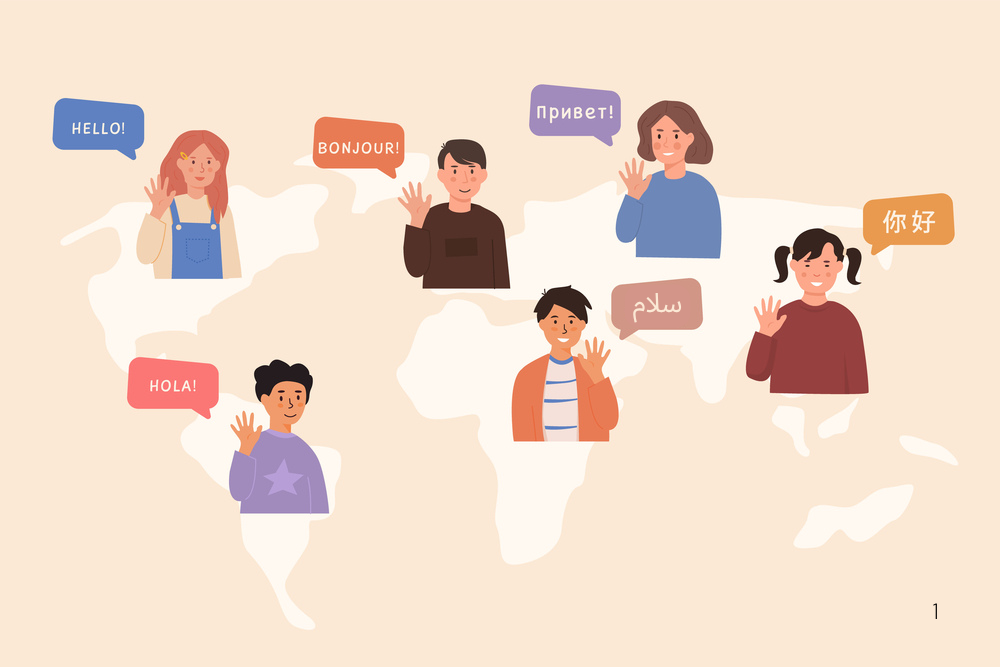
Raising a child is full of challenges. My brother and his wife recently had their first child, and they’re showing all the typical signs of being first-time parents. They’re worried about everything: when the baby cries, when he doesn’t cry, when he eats too much, when he doesn’t eat enough, when he’s interested in something, when he’s not. As a parent, you might worry about your child’s language development, especially if you’re raising a bilingual child and you weren’t raised bilingually yourself. How will your child’s language development compare to children with only one mother tongue?
It turns out bilingualism has its own upsides for children.
Linguistic Cousins – Cognates
To explain why, we need to dive into cognates: words that look or sound very similar (or even the same) across languages and have equivalent meanings. Researchers asked over 300 bilingual children to name objects or actions shown in pictures, sometimes in one language, sometimes in the other. They discovered that children could name words better in both languages if they were cognates. Apparently, children learn these words more easily. The researchers believe it’s because in the brain, word meanings are pooled together, so children don’t have to assign a whole new word form to a meaning – they can use the word form they already know (maybe with a slight update). It’s like a shortcut for language learning!
Some Are More Similar Than Others – Language Distance
Some language pairs are more alike than others. Beyond individual words, they can share similarities in grammar, sentence structure, or the sounds they use. This is called language distance. The closer the languages, the easier children learn them because of the overlaps.
This relates to the findings about cognates, as we’d expect closely related languages to have more words in common. Surprisingly, though, researchers found that children speaking distant languages were even better with cognates. This might be because these children are more sensitive to cognates. Since they have so little in common between their languages, they really make use of these shortcuts that similar words provide whenever they can.
Practical Implications
So what are the takeaways for parents of bilingual children?
- Make use of cognates. Children learn cognates more easily, so you can boost your child’s vocabulary by highlighting these overlapping words. You could even make a game of finding these words in your languages, helping them make connections.
- Mind the language distance. If your child is learning two distant languages, it might take a little longer to build vocabulary. Don’t worry – there’s nothing wrong. With consistent exposure and a fun learning environment, they’ll still succeed.
- Every child is different. Their age, experience with both languages, and parents’ level of education all play a role in your child’s journey to learn a language. As a parent, you know your child best. Focus on creating a learning environment that works best for your child.
Raising a bilingual child is an incredible journey. By understanding how language similarity affects learning words, you can better support your child’s language development and help them unlock the full potential of their bilingual brain!
Writer: Fruzsina Helmeczy
Editor: Jitse Amelink
Translation Dutch: Anniek Corporaal
Translation German: Jule Hafermann
References
Koutamanis, E., Kootstra, G. J., Dijkstra, T., & Unsworth, S. (2024). The role of cognates and language distance in simultaneous bilingual children’s productive vocabulary acquisition. Language Learning. https://doi.org/10.1111/lang.12666