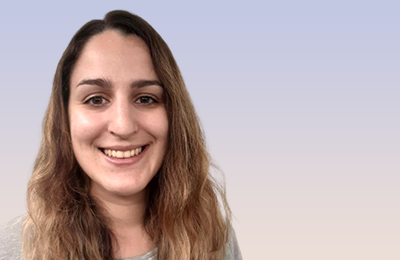
An interview with Dr. Elly Koutamanis
What was the main question of your dissertation?
My research focused on understanding how words from different languages are stored and processed in the minds of children who learn two languages at the same time from a young age.
There were two main research questions in my dissertation:
- How are the meanings and sounds of words from both languages stored in the brain and to what extent do they influence each other?
- To what extent do interpersonal differences, task and situational differences and similarities between the two languages shape how words from each language influence one another?

Can you explain the (theoretical) background a bit more?
Research on late bilingual adults shows that knowing words from two languages can influence language processing. More specifically, bilinguals can process words faster if they sound similar and/or if they mean the same thing across languages. Examples of such words in English and Dutch would be brick and bril ‘glasses’, which start with the same sounds, spoon and lepel ‘spoon’, which mean the same thing, and apple and appel ‘apple’, which overlap in both sound and meaning (these are called cognates).
So we know that in late bilinguals, words that share the meaning or sound in the two languages can be linked and even help each other during language processing. But what about children who grow up with two languages at the same time?
That is what I wanted to find out first – does this kind of lexical cross-linguistic influence occur in simultaneous bilingual children, too? In short, it does! This means that in a bilingual child’s brain, word meaning and sounds from both languages are all connected, and thinking of a word in one language can bring to mind a word from the other language during language processing.
Secondly, to learn more about how speaking one language influences the word choices speakers make in another language, I looked at whether and how it varies between bilinguals depending on the amount of exposure they received to each language. I also looked at how this influence changed across different types of tasks and situations, and in different language combinations.
Why is it important to answer this question?
I think it is fair to say that society cares a lot about bilingual children and child second language learners, with teachers and policy makers trying to find the best ways to boost their vocabulary knowledge, but the focus is typically only on their Dutch language development. How the two languages interact is often overlooked. Also, it is important to understand in detail how bilingual children process languages and how the words of both languages are stored in their brain before we can implement good policy and education for bilingual children.
Can you tell us about one particular project (question, method, findings, implications for science or society)?
In one study, I analysed the results of a Dutch vocabulary test taken by over 300 children. These children were simultaneous or early bilinguals speaking Dutch as well as German, English, Spanish, Greek or Turkish. For each word in the test, I calculated how similar-sounding it was to its translation in the other languages, that is, how much of a cognate it was. I found that the more similar-sounding the words of the two languages are, the more often children knew the Dutch word correctly.
I had expected that this cognate effect would be stronger for the children who spoke more closely related languages that share many similarities (e.g., Dutch-German and Dutch-English) than for the other children. Interestingly, I found the opposite! It seemed like the many similarities between their languages make cognates stand out less for these children. That could mean that differences and similarities between languages in other aspects play a role in how bilingual children process words.
What inspired you to choose your research topic?
Throughout my research, I remained inspired by the Dutch-Greek bilingual children and their families that I visited for my first data collection. I recognized a lot of myself and my own Dutch-Greek bilingual upbringing in them. It meant a lot to me to be able to pay attention to this small minority community in my work.
Can you share a moment of significant challenge or failure during your PhD journey and how you overcame it?
I was almost ready to start my second data collection, where I would visit more Dutch-Greek and also Dutch-German families, when Covid hit. At first, I thought I’d wait it out, but it soon became clear that I needed to change my plans. It took a lot of effort and trial and error, but in the end we collected data from over a hundred children living in the Netherlands, Germany and Greece, fully remotely. Children performed several tasks in online experiments, instructed by animated characters in videos that I created, and experimenters who were present through video calls. The parents also helped us, by setting up recording devices so that we could even collect reaction times from the children’s speech!
What do you want to do next?
I work as a researcher at the Expertisecentrum Nederlands in Nijmegen. This is a research institute focusing on language (in) education, often commissioned by the government. One of the projects I am currently involved in is a large-scale study of the levels of English that children have at the end of primary school. I am learning a lot about education and educational research, which I find very interesting! I also like that I am now involved in multiple projects at the same time, which is very different from the one big (sometimes scary) PhD project!